Renderful vs fal.ai: Which AI API Platform Should You Choose?
TL;DR
Renderful offers 144+ curated AI models spanning video, image, audio, music, and LLMs with pay-as-you-go pricing and a single REST API. fal.ai focuses on image and video models with strong GPU infrastructure and fast inference. Choose Renderful for broader model coverage and agent-native workflows; choose fal.ai if you prioritize raw GPU speed for image-heavy workloads.
Both Renderful and fal.ai provide API access to AI models for image and video generation. If you're building an application that relies on generative AI, choosing the right API platform matters. This comparison breaks down the key differences between Renderful and fal.ai to help you decide.
Overview
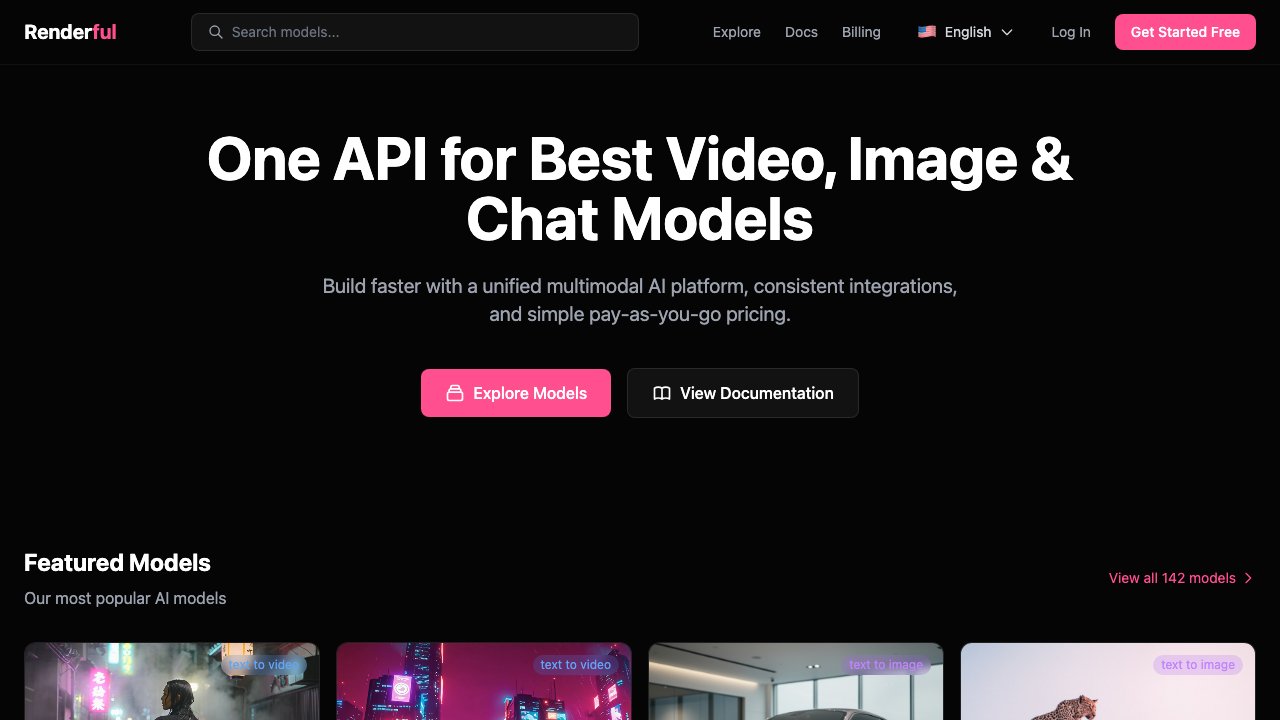
Renderful is a unified AI API platform that gives developers access to 20+ models spanning video generation, image generation, audio, music, and LLMs through a single REST API. It supports models like Sora, Kling, Flux, GPT-4, Claude, Suno, and more — all under one API key and billing account.
fal.ai is an AI inference platform focused on fast model serving. It provides API access to popular image and video generation models like Flux, Stable Diffusion, Kling, and WAN, with an emphasis on speed and developer experience.
Feature Comparison
Here's a side-by-side look at what each platform offers:
| Feature | Renderful | fal.ai |
|---|---|---|
| Video Models | Sora, Kling, Seedance, WAN, Hailuo, Veo + more | Kling, WAN, Pika, Veo + more |
| Image Models | Flux, Seedream, GPT Image, Recraft + more | Flux, Stable Diffusion + more |
| Audio / Music | Suno, ElevenLabs | ElevenLabs |
| LLM Access | GPT-4, Claude, DeepSeek | No |
| Pricing Model | Pay-per-use | Pay-per-use |
| Free Tier | Yes (free credits) | Yes (free credits) |
| Webhooks | Yes | Yes |
| SDKs | Python, JavaScript, REST | Python, JavaScript, REST |
| LoRA Training | Yes | Yes |
Pricing Comparison
Both Renderful and fal.ai use a pay-per-use pricing model, meaning you only pay for the generations you run. Neither platform requires a monthly subscription or upfront commitment.
Per-model pricing varies depending on the specific model, resolution, and duration. Renderful aims to offer competitive rates across all supported models while providing the convenience of a single billing account for every model you use.
Both platforms offer free credits on sign-up so you can test the API before committing. For detailed per-model pricing, check the Renderful pricing page.
When to Choose Renderful
Renderful is the better choice if you need:
More Video Models
Access Sora, Kling, Seedance, WAN, Hailuo, Veo, and more video generation models through a single API.
LLM Access
Use GPT-4, Claude, DeepSeek, and other large language models alongside your image and video models without a separate integration.
Unified Billing
One API key and one billing account for every model. No need to manage multiple provider accounts and invoices.
Broader Model Coverage
From video and image generation to audio, music, and LLMs, Renderful covers more AI categories than fal.ai.
When to Choose fal.ai
fal.ai may be the better choice if you need:
Established Platform
fal.ai has been in the market longer and has a proven track record for serving image and video generation workloads.
Large Community
A larger existing user community means more tutorials, examples, and community-built integrations are available.
More Infrastructure Options
fal.ai offers additional infrastructure features like custom model deployment and dedicated GPU options for enterprise workloads.
Frequently Asked Questions
Is Renderful a good alternative to fal.ai?
How do Renderful and fal.ai pricing compare?
Which platform has more AI models?
Can I switch from fal.ai to Renderful?
Do both platforms support webhooks?
Related Articles
Try Renderful Free
Create your Renderful account, get free credits, and start generating with Sora, Kling, Flux, GPT-4, and 20+ other AI models through a single API.